
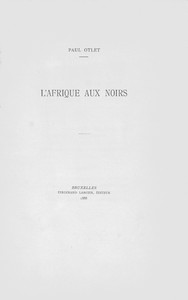
L'Afrique aux Noirs by Paul Otlet
This isn't a novel. Forget about characters or a traditional plot. 'L'Afrique aux Noirs' is a political blueprint. Published in 1891, it's a young Paul Otlet's detailed proposal for European powers to carve out a huge, sovereign state in the heart of Africa—stretching across much of the Congo Basin. He argues they should do this not to rule it themselves, but to establish a self-governing nation for Black Africans, complete with its own laws, leadership, and international recognition. He maps out everything from government structure to economic development. The 'story' is the sheer audacity of the idea itself, laid out with the dry, systematic logic of a man who would spend his life trying to organize all the world's knowledge.
Why You Should Read It
Reading this book is a trip. Otlet's mind was clearly ahead of its time in some ways—he's advocating for African self-rule decades before mainstream decolonization movements. But then you hit passages where he casually discusses European 'guidance' or the strategic benefits for Europe, and you cringe. It's this jarring mix of idealism and paternalism that makes it so compelling. You're not just reading history; you're inside the head of a complex thinker at a specific moment, wrestling with the biggest ideas of empire, race, and progress. It makes you think hard about the gap between good intentions and real justice.
Final Verdict
This is a niche but mind-expanding read. It's perfect for history buffs who love primary sources, or anyone fascinated by the strange, often forgotten ideas that floated around during the Scramble for Africa. If you're into the history of utopian thinking, international law, or even the early seeds of information science (Otlet's later passion), you'll find gold here. Just be ready for a challenging, document-style read that asks more questions than it answers.
This historical work is free of copyright protections. You can copy, modify, and distribute it freely.
Richard Baker
1 month agoI didn't expect much, but the presentation feels refined and carefully planned. Simply brilliant.
Joseph Hernandez
5 months agoAs an avid reader, the explanations feel carefully crafted rather than rushed. This turned out to be a great decision.
Nancy Perez
2 weeks agoThis immediately felt different because the material feels polished and professionally edited. I learned so much from this.
Steven Lewis
3 months agoAs someone who reads a lot, the author clearly understands the subject matter in depth. I'm sending the link to all my friends.


Melissa Thomas
5 months agoI almost skipped this one, yet the author demonstrates strong mastery of the topic. Worth every second of your time.